
 This month’s article continues Dal-Bac Manufacturing’s content series: Focus on Client Satisfaction. At Dal-Bac Manufacturing, we see continuous improvement as more than a business philosophy, it’s how we deliver reliable, high-performance lamination every time. For over 40 years, we’ve specialized in flame lamination, constantly refining our methods to deliver reliable, consistent results no matter the challenge.
Many of our customers come to us after a disappointing experience with another laminator. When precision slips, the costs add up quickly—materials get wasted, deadlines are missed, and confidence takes a hit. Flame lamination is a balancing science. When that balance is off, the product suffers. Here are the most common lamination problems we see—and how Dal-Bac’s continuous improvement mindset eliminates them.
Problem #1: Delamination and Weak Adhesion
The problem: Layers that delaminate or separate over time, leading to peeling, curling, or complete product failure.
Why it happens: Some laminators rely on liquid adhesives that expire, mismatch with substrate surface energy, or fail under real-world conditions.
 How Dal-Bac fixes it: Our ISO 9001:2015 certification means every process is tested, measured, and documented. Our flame lamination process melts foam that holds layers of flexible substrates, creating a permanent bond without adhesives that degrade or age out. The result is a stronger, cleaner, cheaper and more sustainable solution with fewer process variables to manage.
Problem #2: Wrinkling and “Tunneling”
The problem: Misaligned or uneven surfaces can produce visible wrinkles tunneling in the laminate surface.
Why it happens: Misaligned rollers and one-size-fits-all tension settings are the usual culprits. Different materials require different handling, but many laminators overlook that.
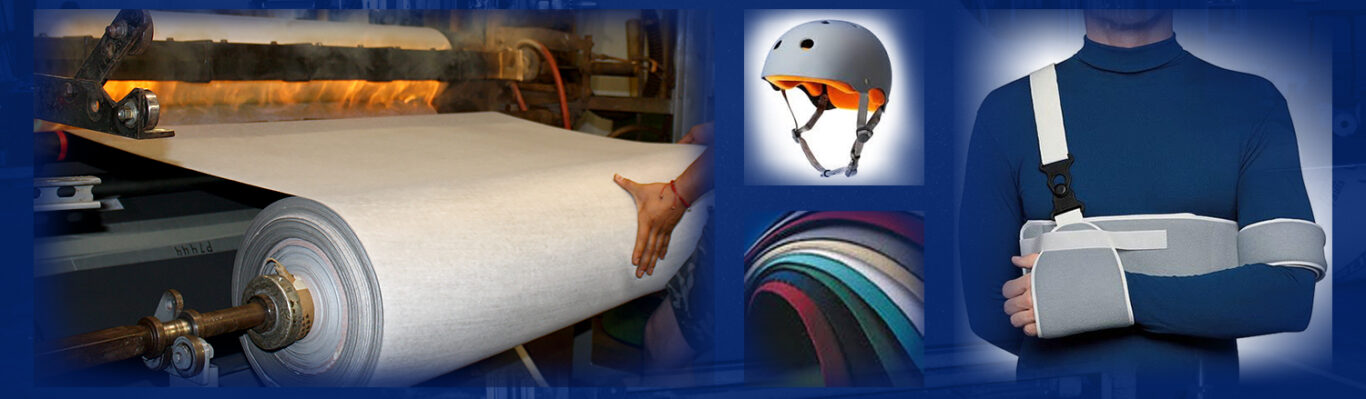
How Dal-Bac fixes it: We take a precise, material-specific approach to lamination. With advanced converting solutions and proven expertise in laminating materials of disparate thicknesses, we maintain exact web tension throughout the process. That control lets us laminate materials up to 3/4” thick without the wrinkles or surface variations common in standard setups.
Problem #3: Bubbling and Hazy Finishes
The problem: Trapped air or humidity can cause bubbles, haze, or inconsistent finishes – especially in medical or automotive applications.
Why it happens: Inconsistent roller pressure or uncontrolled environmental moisture often introduces air or moisture into the bond.
How Dal-Bac fixes it: Our process is tightly controlled from start to finish. We maintain precise roller parallelism. The outcome is a smooth, clear, blemish-free finish every time.
Problem #4: Material Distortion
The problem: Some laminated products curl or distort after cooling because of uneven tension or mismatched material tension.
 Why it happens: Many laminators treat every substrate the same, ignoring how materials expand and contract at different rates.
How Dal-Bac fixes it: We tailor each solution to the specific material behavior. Our team prototypes and tests internally. Samples are then sent to customers for approval before production, ensuring every laminate performs as expected in fit, form and function. That attention to detail means your final product maintains its integrity and shape long after it leaves our facility.
Setting a New Standard – One Laminate at a Time
At Dal-Bac, lamination isn’t just a process – it’s a craft we’ve spent decades perfecting through continuous improvement. Every adjustment, test, and data point moves us toward better performance, tighter tolerances, and more consistent outcomes.
From orthopedics to automotive seating and advanced composites, our success comes from a simple principle: pay attention to every detail and never stop refining.
If you’re tired of dealing with delamination, wrinkles, or unreliable results, it’s time to experience the Dal-Bac difference. Contact our team today to discuss your next project or request a prototype run designed to show what true precision looks like.